
Top takeaways from this post:
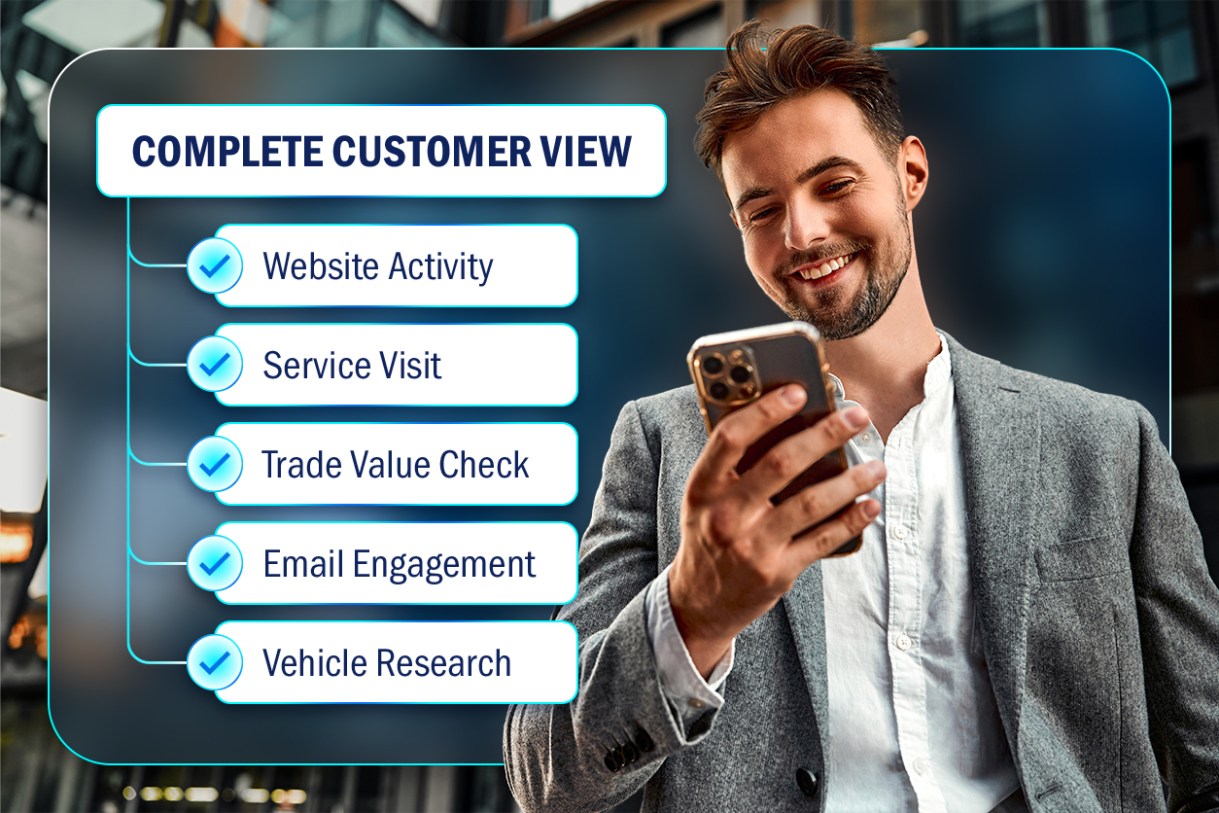
- Dealership customer data is often split across CRM, DMS, marketing, website, and service systems. This makes the full customer journey hard to see.
- Changing shopper behavior, agentic AI, and tighter margins make unified customer data a business priority.
- Connecting customer signals, business insights, and employee actions helps dealerships identify opportunities and personalize engagement.
Ask any dealer principal to count how many systems it takes to understand a single customer. Then wait for the pause.
It’s usually four or five: a CRM, a DMS, a website analytics dashboard, a marketing platform, sometimes a separate service scheduler. Within that pause is a hard truth about the automotive industry. Nobody in the building has the whole picture of any one customer. They have fragments of it, scattered across systems that were never built to talk to each other.
This isn’t a technology failure. It’s a structural one. And it’s about to become the defining competitive question in automotive retail.
The Current State: More Data, Less Understanding
Every dealership today collects more customer data than at any point in its history. Website behavior, service history, financing inquiries, trade appraisals, marketing engagement all exist, somewhere, in some system. And yet ask a sales rep what a walk-in customer did on the dealership’s own website last week, and they have no idea.
That gap has been hiding in plain sight because the industry has spent a decade optimizing the wrong unit of value. Retail has organized itself around the capturing and measuring of leads, or the moment a shopper raises a hand and enters a funnel. But by the time that happens, the shopper has often already done the majority of their research: comparing vehicles, checking pricing, reading reviews, visiting a service bay for an unrelated reason entirely.
“The lead was never the beginning of the relationship. It was somewhere in the middle.”
Retail systems built to manage leads are, by design, optimized for a single moment — the point a shopper raises a hand. Everything that happened before that moment often exists somewhere in the business, but it rarely reaches the person having the conversation, which turns out to be most of what actually matters.
The Forces Driving Change
Three forces are converging to make this gap impossible to ignore any longer.
First, shopper behavior has moved further upstream than retail systems have followed. The research phase of a vehicle purchase now happens almost entirely before any dealership knows a shopper exists, spread across search, marketplaces, social content, and a dealership’s own digital properties that nobody’s watching in real time.
Second, AI has crossed a threshold that matters more than most coverage of it acknowledges. The conversation about AI in retail has mostly been about generative tools that draft emails or answer chat messages. These are useful, but fundamentally reactive. The more consequential shift is toward agentic systems: AI that doesn’t just respond to a prompt but reasons across multiple data sources, identifies what matters, and initiates action on its own. The distinction between AI that helps you write something and AI that notices something needs doing and does it is the difference between a feature and an operating model.
This shift is arriving at a moment when both consumers and dealers increasingly view AI as central to the future of automotive retail. Recent industry research found that 83% of consumers believe AI will completely reshape the car-buying experience within the next decade, while 63% of dealers agree that investing in AI is critical for long-term success1.
Third, the economics of retail have tightened enough that the cost of a missed signal is no longer an acceptable rounding error. A service customer who’s quietly become a trade-in opportunity, a high-equity owner nobody flagged, or a shopper who went dark simply because the follow-up was generic instead of relevant used to be shrugged off as the normal friction of doing business. In a market where every deal is contested, they’re now the difference between a good quarter and a mediocre one.
What the Next Chapter Looks Like
Retailers who pull ahead over the next several years won’t be the ones with the most data. Data collection itself is becoming commoditized. What will set them apart is how well they connect three things: customer signals, business insights, and employee actions.
“THE WINNERS WON’T BE THE ONES WHO ARE BEST AT COLLECTING DATA. THEY’LL BE THE ONES WHO ARE BEST AT CONNECTING IT.”
Today, that loop is broken at every joint. Signals get captured in one system and never reach the person who needs them. Understanding, when it exists at all, sits in a dashboard nobody opens during a live customer conversation. Action, when it happens, is disconnected from both — a generic follow-up sent to someone whose actual behavior would have suggested something entirely different.
Agentic AI is the first technology capable of closing that loop end to end, not because it’s clever marketing, but because reasoning across fragmented systems and initiating the right next step is exactly the kind of problem it’s structurally suited to solve. The next chapter of retail technology isn’t going to be defined by better dashboards or smarter chatbots. It’s going to be defined by whether an organization’s systems can quietly do the work of noticing what a customer needs and acting on it before a human must ask.
A Call to the Industry
Unified data can’t stay a back-office IT project — it’s a business priority. Success can’t be measured only by the number of leads generated. The more important question is whether anyone, or any system, can see the customer’s full relationship across sales, service, marketing, and digital channels. For most retailers, the answer is still no. That needs to change. The retailers that connect the full customer experience first will have a clear competitive advantage.
Closing
We’ve spent the better part of a decade teaching customers to expect personalization everywhere else in their lives. They experience it when they shop, stream, bank, and communicate. The only place they don’t see it is when they’re making one of the largest purchases they’ll make all year. That’s not a technology gap anymore. It’s a choice.
The dealerships that pull ahead won’t necessarily be the ones with the most customer data. They’ll be the ones that do the best job recognizing customer intent, uncovering opportunity, and turning insight into action. The future of automotive retail isn’t about collecting more information. It’s about making better use of the signals that already exist.
Stay Ahead of What’s Next in Automotive Retail
Your team needs a clear way to identify active shoppers, personalize follow-up, and reply to customers.
Learn how VinSolutions helps dealers connect customer signals and business insights.
“The dealerships that win the next decade won’t be the ones who collected the most data. They’ll be the ones whose systems finally stopped pretending that data didn’t already exist.”
1. 2025 Cox Automotive Car Buyer Journey Study